


Spring newsletter 2026
“I love spring anywhere but if I could choose I would greet it in the garden”
Ruth Stout
Hello fellow gardeners,
As I look out of my window at the rain, I am hoping that it will be fine for the workmen I have employed to lay the foundations in a couple of days’ time for a new potting shed. As the spring season starts in a new gardening year I am excited at the prospect of the difference my acquisition will make to the appearance of the kitchen garden. I have already had to make changes to the area where my shed will be positioned. Pruning a tree and removing a large ivy-clad structure has increased the light levels in the area which will benefit some of the plants in an adjoining border. There will be painting to undertake and some re landscaping of the whole area before the shed will look like it ‘belongs’ in its space. Changes in planting have similar effects although as gardeners we have to wait a while to find out! Unless we buy fully grown plants for instant effect (and who does?) we have to wait for them to settle in- to become comfortable and established in their new situations; to adapt to their new surroundings. I know those in my adjoining border that would have initially preferred a tad more sun will now get it and be very happy. Happy plants are what we all strive for in our gardens and we can ensure they will be content by providing the good growing conditions they need. This starts with the soil of course, so as spring beckons it’s not too late to feed borders with all the organic matter we can find. Good soil is the key to producing healthy ornamentals and food fit to eat. It’s too cold in early March to start planting so this is the perfect time to get out into the garden and improve conditions for all that is animal, vegetable and mineral! Treat the organic matter as you would a mulch and let the worms take it into the ground building up its’ fertility. Bare rooted shrubs should be available now for planting in reasonable weather so if you really can’t wait to get started put these in at the same time. You can start pruning those you already have now. Jane Allison’s talk ‘Shrubs for all seasons’ on April 21st might open up the possibilities of a few more to plant in your garden too. Putting the right plant in the right place is another method of ensuring plants will be happy. Those that prefer shade are never going to do well in full sun and visa versa. When I have gaps to fill in the borders or want to improve the overall look of an area, I find it easier to make a list of those plants that I think might fit the bill visually and then tick off those that will suit the conditions they are going to live in. As one gets more experienced as a gardener we learn more about which plants can cope with sun or shade and how much moisture they will need. When I think about the lists I’ve made over the years, there always seems to be one genus that crops up on them all - the hardy geraniums. Hardy geraniums (not to be confused with pelargoniums) are amongst the most popular of hardy perennials because they are so easy to grow .There are geraniums for full sun and those that prefer shade or part shade. They come in so many different forms from neat mounds to vigorous ground cover. Easy to care for, this versatile genus has varieties that can be used as a background to other plantings or as front of the border blasts of colour. If sun lovers are what you want that give months of colour choose from Geranium magnificum, G. oxonianum, G. sanguineum G. clarkei or G. renardii varieties. Geranium phaeum and G. nodosum prefer shade. Geranium phaeum will wilt if placed in full sun which is not a pretty sight! Try it combined with any of the larger hostas e.g. Hosta elegans, Hosta ‘Great Expectations’ or Hosta’ Thomas Hogg’ for a dramatic effect in a shady site. Tellima grandiflora looks nice too, setting off the darker flowers of Geranium phaeum ‘Lily Lovell’ or G. ‘Samabor’ with its erect racemes of small cream flowers.
I can confidently state that there is a geranium for every aspect of the garden and I am sure Don Witton would agree with me and include some in his talk on May 19th entitled ‘Vibrant Summer Perennials’.
G.psilostemon will tolerate light shade as will G.macrorrhizum. All geraniums and their hybrids come in shades of pink, purple and white. The foliage varies from plain green to green with dark or yellow markings. Varying in size they can be very filigree in appearance, as with Geranium pratense ‘Midnight Reiter’, G.maculatum ‘Espresso’ or G.’Nimbus’ to the heavily yellow mottled G. phaeum ‘Conny Broe’

Geranium magnificum

Geranium oxonianum ‘Wargrave Pink’
The ‘oxonianums’ have pink flowers in mainly light shades. They will grow in sun and light shade and all can be enjoyed in the garden from early spring, when they start to form dense green mounds, until late into the autumn. When the first flush of abundant flowers appears in late spring they will look an absolute picture at the front of any border. After flowering has finished they will need shearing down to the base from where another mound of foliage will come quickly together with more flowers. Geranium oxonianum can get a little too big for its boots sometimes by spreading its stems though the border rather untidily. However, this can have its advantages when paired with more upright border perennials to make nice combinations of colours and textures. Nice varieties with good strong colours to look for are G.oxonianum ‘Julie Brennan’, G.O. ’Claridge Druce’, G.O ‘Wargrave Pink’ and G.O ‘Summer Surprise’

Geranium macrorrhizum ‘Bevan’s variety’ and ‘Ingwersen’s variety’

Geranium pratense
Geranium magnificum is completely different in colour and stature. It flowers in late May for me, and is the most beautiful purple blue. This geranium has been known for over one hundred years. It is probably the only geranium that doesn’t repeat flower after cutting back but I appreciate it even more because of this! I could look for G. ‘Blue Blood’ G.’Rosemoor’, G. ‘Peter Yeo’ or G. ‘Turco’ to obtain plants in the same ilk that would give me continued flowering. Geranium renardii ‘Philippe Vapelle’ looks very similar but has a glaucous colouring to the leaf which I find charming. Similar in colour is the hybrid Geranium ‘Nimbus’ with very finely divided foliage. Geranium psilostemon and its hybrids have much more red pigment in their flowers making them all ‘in your face’ vibrant cerise! Most need to be placed near to the front of the border as this colour tends to ‘get lost’ in the foliage of the plants when placed towards the back. G. ‘Anna Folkard’ and G. ’Patricia’ are popular. The latter looks good with silver foliage plants or those with strappy leaves to provide a contrast. Both will grow up to 120cm in height and will need supporting. Much smaller but just as endearing is Geranium nodosum. This is a good candidate for those difficult shaded places we all have in our plots.


G.N ‘Whitleaf’
G.N. ‘Blueberry Ice’
Geranium nodosum
It seeds around nicely and is most suitable for a woodland garden. There is a white variety as well as the lilac/ blue ones. The name ‘Whiteleaf’ doesn’t describe the leaf. The plant is named after the house where the original sport was found in the owner’s garden. You might find any of these geraniums for sale at our Spring Fair on Saturday May 9th and will certainly come across them at RHS Harlow Carr if you join us when we have our coach trip to visit on May 21st.
Tickets for this will be on sale at our meeting on March 17th when we will also be treated to an evening with Steven Lowe. Not to be missed!
Before I go out looking for more hardy geraniums at the nurseries, I think it would be worth purchasing a reference book on the subject. Those with plenty of images would serve me best as there are so many to choose. Second hand books at give away prices on well known websites on the ‘net’ are always a good buy. In the spring garden, I’ll start by cutting back all the dead foliage left on the plants in the Pond Garden and giving it a jolly good tidy up, cleaning the greenhouse because I neglected to do it in the autumn, sowing seeds and growing them on,
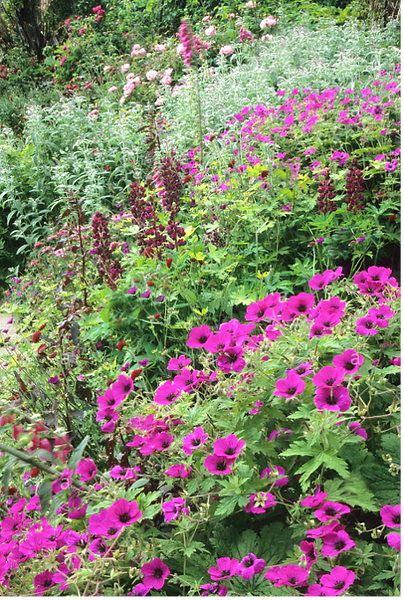

Geranium Psilostenum "Patricia"
Geranium Psilostenum "Anna Folkard"
planting the kitchen garden, feeding the grass, removing nets from ponds, repotting succulents, tying in climbers, cleaning paths, repairing trellis and raised beds, pruning the greengage tree and of course, painting my new shed. After a lazy winter, there’s so much to do in spring but hey ho…………..“it’s a new dawn, it’s a new day , it’s a new life for me and I’m feeling good” !
Happy gardening.
