


“Don’t put off till tomorrow what you can do today” - Lord Chesterfield
Hello fellow gardeners,
I think we can safely say that it has been another wonderfully hot summer and mild autumn and, even before we head into winter proper, as I write the weather is again, unseasonably mild. However, the cold frosty days won’t be far away and there is still plenty to do before we can put our feet up and let nature do its thing for a few weeks. There is a long list of jobs that need attending to in my garden this winter and top of it is the purchase and planting of a couple of step over pear trees. I have removed the two pyramid apple trees from the kitchen garden because they had outgrown their spaces and I’m going to replace them with ‘Step over’ pear trees. Step overs are basically one tier espaliers that are low enough to ‘step over’. They remain small (18ins - 24ins above ground) due to judicious pruning every year.


Apple Tree Removal

Step Over
They are supplied in a ‘Y’ shape with two main shoots that can be trained out in opposite directions and have the advantage of taking up very little space and so not to decrease the light levels in an area of the garden that needs as much of it as possible. I am going to order two year old specimens that have been pruned appropriately. The variety I have chosen is Williams’ Bon Chretien’ because I already have ‘Concorde’ in the garden so would like another pear that will cope with a northern climate. It will, of course be interesting and exciting to learn about how to prune and care for my new acquisitions. After that I will be wrapping pots on the terrace and covering them with fleece bags, pruning the laurel hedge and the blackcurrants and manuring the borders. It feels good to see the garden looking tidy over the winter which means making sure that equipment and tools are put away and making sure that as much cleaning of pots and greenhouse takes place. I don’t like to put these tasks off until spring.


Cleaning, bubble wrapping pots and protecting tender plants with a fleece bag.
Other tasks for winter include:
-
Net ponds after removing leaves
-
Cover benches and tables to protect from bad weather
-
Continue to plant deciduous trees and shrubs
-
Prune fruit trees (not plum)
-
Plan a herb garden
-
Make or renovate raised beds
-
Put fleece over tender specimens in the greenhouse
-
Make sure compost bins are covered and not water logged
-
Sweep paths and put any leaves in the leaf mould bin
-
Paint new trellis indoors if possible
-
Plant roses if the soil is dry
-
Purchase seed (flowers, vegetables) and order summer flowering bulbs if not done
I always order my vegetables and annuals during the winter and try to include a few new plants each year because I like the excitement of growing something different. Some of the lovelier annuals sell out pretty quickly so I order these as soon as the catalogues arrive or when websites are updated by the seed companies.
This season I have included Centaurea cyanus ‘Black Ball’ instead of the usual Scabious atropurpurea.

Scabious atropurpurea

Centaurea cyanus ‘Black Ball’
The Centaurea will be lot easier to germinate than the Scabious. It is a tall variety and I love the colour of its deep maroon flowers which I intend to use in pots on the terrace. I will no doubt, will be able to buy the Scabious as a plant at the garden centre. I always grow lots of cosmos and for next year I have chosen to include Cosmos bipinnatus ‘Fandango’. This is a semi double vibrant pink early flowering plant. It is a good height for a pot at 2.5ft high. The colour is amazing! The grasses I have bought will also be used in pots. Both are very decorative and will go very well with more robust flowers. The Panicum elegans ‘Sprinkles’ will look beautiful in a vase with dahlias or lilies and Lagarus ovatus ‘Bunny tails’ is so charming. The last of my new purchases is Anethum graveolens ‘Mariska’. At 2ft high, this variety of dill makes a very good cut flower, is long lasting and has a beautiful fragrance.

Cosmos bipinnatus ‘Fandango’

Panicum elegans ‘Sprinkles’

Anethum graveolens ‘Mariska’
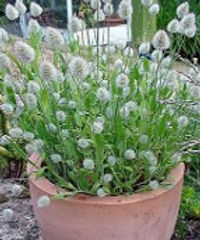
Lagurus ovatus ‘Bunny Tails’
Whilst I get busy continuing to clear away the remains of the leaves that have fallen on the paths, I am reminded of the need to leave something for all the other creatures that inhabit the garden. Some of the apples and pears that fell long ago from overladen trees are still rotting down on the borders and the lawn remains unmown until next week when it will be given its last cut. After taking stock of what I have included in the garden (e.g. ivy, ponds, shrubs) I can now say that I am doing my bit for ‘renaturing’, the next trendy ‘ism’ to enter gardening vocabulary! I’m informed by a University director of wild writing (in an edition of the glossy gardening magazine that lands on my doormat every month) that “Renaturing’ (we should stop saying ‘rewilding’) “is about seeing the garden as an ecosystem, getting curious about what visits and grows there”. Of course my neighbour, who feeds the birds in winter will be playing his part in this process too. He is really curious about what visits his bird table! He is taking care of the birds but will he want to know he is ‘renaturing’ as well? It seems that in these times there has got to be some new trend, method of working or new name for what we gardeners do in order to keep us all alert for the need to consider other forms of life in the natural world. If you are one of those people who don’t feel you are doing enough for this cause, think again. Unless you have a garden that is restricted to accommodating one genus or variety of plant, and you grow all types of plants, you will have a biodiverse environment. You will have created a range of habitats in which natures other beings can live. Of course if you grow organically, you will be helping them even more by encouraging a balance of life forms. Trust me when I say that you don’t need to swap your lawnmower for a scythe or grow brambles to achieve this. The writer of said article ‘suggests’ that one could “sit back and give your garden a full year to do what it wants to do”. Really? I have seen what the end result of doing this looks like and have witnessed the hours of strenuous hard work my neighbour (the one who feeds the birds) has had to undertake on the resulting forest of brambles, bind weed, nettles and couch grass to get his plot back to the garden it once was! Putting off the work intentionally or otherwise means it is twice as difficult to do it when we do get round to it. Letting nature takes its course results in no garden at all.


The definition of a garden is “A planned outdoor space for the cultivation and display of flowers, fruits or vegetables”
“It (a garden) is a grand teacher –it teaches patience, and careful watchfulness; it teaches industry and thrift; above all it teaches entire trust” -Gertrude Jekyll
We all feel much better when a job is done well and, after we have finished getting the garden in good order we can relax a little. Our Christmas festivities with musical entertainment and refreshments on December 16th will be a welcome break for us all. Why not come along and join in the fun? As is the custom at this time of year, we make our New Year resolutions.
Why not join with me to include a few gardening ones:-
Forget all trends.
Garden organically.
Grow only what I like
Don’t put off till tomorrow what I can do today
Getting back to what we all do best, we finish our society’s winter programme and start our new year with our AGM and Hot Pot supper on January 20th, 2026 and with a talk by Steve Halliwell on February 17th, 2026 entitled ‘Yes we have no Galanthus – The story of the humble snowdrop’
Merry Christmas and a happy gardening New Year
Moe